
Life and Memory in Old Pirton
In May 1984, Miss Vera Davis of Pirton Grange sat down to share her memories of village life in the early years of the twentieth century. Born in 1907, she was the daughter of Robert Davis of Rectory Farm — a family whose roots in Pirton reached back to the early seventeenth century. Her recollections offer a vivid portrait of a rural community bound by work, faith, and quiet pride in local life.
A Family Deeply Rooted in Pirton
The Davis family had farmed at Rectory Farm since 1870. Vera’s grandfather, Daniel Davis (born 1821), grew up in nearby Hexton and attended the British School at Old Hall before pursuing further education elsewhere — a mark of the family’s long-standing respect for learning. Daniel died in the mid-1890s, but his descendants remained at Rectory Farm until 1931, when they moved to Pirton Grange. Vera’s father, Robert Davis, passed away in 1947.
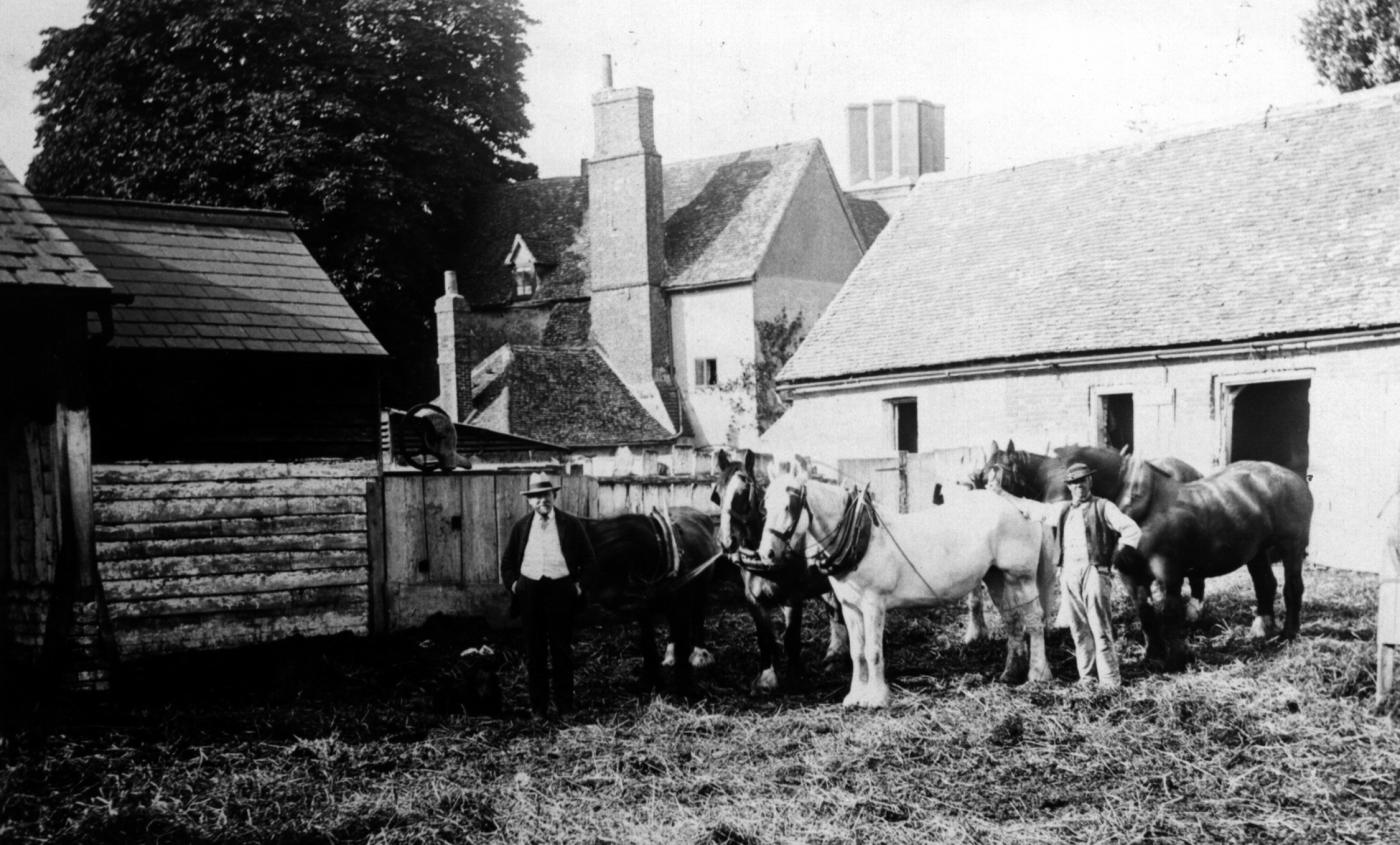
the manor house for Rectory Manor and is basically a typical Elizabethan house, although much altered in later centuries. Previously farmed by tenants of absentee landlords, who were lay rectors of the parish, it was the first farm to be purchased and farmed by its owner, Daniel Davis, who bought it in 1870 for £17,500. His son, Bob Davis seen here (left) with his horse keeper, became a local councillor and chairman of the school board. Davis Crescent is named after him.
Robert Davis was not only a farmer but also an active figure in the life of the village. As chairman of the local School Board, he believed that education should serve all, regardless of denomination. In an age when Church and Chapel often stood apart, he made a point of appointing Nonconformist headmasters, reasoning that while the vicar naturally led the Church, the schoolmaster should lead among the Nonconformists. “It was right to do so,” Vera recalled simply, summing up her father’s quiet sense of fairness.
Schooldays and ‘Thimble Drill’
Vera’s own childhood memories centre on Pirton School, where she sometimes accompanied her father to check the register and the punishment book — often with a hound pup or two padding behind them. She remembered Mrs Donson, affectionately known as “the Governess,” and the tiered gallery where the children sat in rows.
There was formality in small things: infant girls curtsied as they entered the classroom, and lessons in needlework included the curious “Thimble Drill” — a kind of physical exercise for the fingers, carried out to commands such as “Pick up thimble! Hands on heads!”
The young schoolmaster Mr. Housden, a keen footballer, became a village favourite, reflecting Pirton’s long love affair with the game. “Pirton was always very keen on football,” Vera noted.
Faith, Families, and Local Characters
Religious life in early Pirton was lively and occasionally contentious. Vera recalled the “very High Church” Reverend Loughborough, who built Pirton House opposite the Vicarage as a school for his sons and a few boarders. There were disagreements with the Pollard family — Joseph Pollard, once a Quaker, had “married out” but remained deeply committed to education. The Donson family, too, left their mark: two of the three Donson daughters went on to become headmistresses, one in Hitchin and the other in Barnet.
Women held a strong place in Pirton society. Straw plaiting provided them with an independent income, often greater than that of their husbands. “What they said went,” Vera remarked, capturing both the practicality and quiet authority of Pirton women.
Sunday Customs and Village Treats
Sundays in Pirton followed a well-worn rhythm. On their way to church or chapel, children carried the family’s dinner to the bakehouse — Ashton’s, opposite Hanscombe Cottages in Shillington Rd — and collected it afterwards, cooked to perfection. The annual Sunday School treat was a highlight: prizes for boys were always black ribbed woollen socks, though Vera could not recall what the girls received. Her mother provided sweets from large jars of “King of All Mixtures,” carefully portioned into paper bags. She disapproved of the usual free-for-all sweet scramble, which she deemed “unhygienic.”
After the First World War, Church and Chapel combined their treats for the first time. The Strict Baptists, however, withdrew before the band began to play — three musicians performing four tunes, repeated cheerfully from four until ten o’clock in the evening.
Clothes, Games, and Simple Pleasures
Everyday life was marked by simplicity and thrift. Boys wore celluloid collars, breeches, and black wool stockings, while girls dressed in long frocks with white or butcher-blue pinafores. Games were made from whatever could be found: footballs bought after long saving, “cat and stick,” hopscotch chalked on the tarred path from Rectory Farm to Mr. Andrews’ on the Knoll — a lane known locally as Pudding Bag Alley, for being open at only one end.
Children played with spinning tops and whips, catapults, and handmade toys. Imagination was their playground.
Working for Pennies
Many village boys earned a few pence as Saturday helpers at the farm. They collected eggs laid outdoors — one penny for twenty — or weeded the cobbled paths for twopence an hour. Their names were chalked on a slate in the kitchen, and the wages soon found their way to the sweetshop for blackcurrant jelly, vinegar flats, lucky dips, or sherbet dabs.
The Adult School and Village Life
Before the First World War, Pirton also boasted an Adult School, run by Vera’s mother and the family governess. Affiliated with the Quakers of Hitchin and Miss Whiting, it offered embroidery, plain sewing, and fellowship, much like a later Women’s Institute. Once a year, the group staged a concert in the village — the stage, Vera remembered with amusement, was “very wobbly,” but the performances were full of local talent and pride.
A Vanished World Remembered
Through Vera Davis’s recollections shines the portrait of a village both industrious and close-knit — where faiths coexisted, women worked deftly with straw, and children’s games filled the lanes. Her memories remind us that the life of rural England was not static or quaint, but full of energy, self-reliance, and community spirit.
For Pirton, as for many English villages, it was the everyday lives of families like the Davises that gave the place its enduring heart.
Interviewed 5/10/84
MissVera Davis, Pirton Grange Daughter of Robert Davis of Rectory Farm – b. 1907
Davis’s at R.F from 1870. (R Davis was 45 when married)
Grandfather Daniel b.1821 lived at Hexton, and went to a British School at Old Hall before going away to school. Died 1894/5. Family has been in area since 1600.
Gardener at R.F had attended the Plaiting School
Davis’s lived at R.F. until 1931, then went to Pirton Grange. Father died 1947.
(Miss D had 2 sisters)
Miss D remembers going to Pirton School with her father who was Chairman of Board. Mrs Donson was known as “the Governess”. Infant girls curtsied when they went in (which she liked). Gallery went up in tiers.
“Needlework for Elementary Schools” in which was “Thimble Drill” – done by numbers, i.e. 1. Pick up Thimble etc. → Hands on heads.
Remembers walking up long room (Mr D’s room) with father, a hound pup or two at their heels, to check register and punishment book.
In those days, a Head was appointed who would be good for the village. Mr Housden was young and a good footballer – Pirton always very keen on football.Her father always appointed a Nonconformist – the Church had the Vicar – and he believed that it was right to do this, as the schoolmaster would be the logical leader of the Nonconformists.
Rev. Loughborough was very High Church – quarrelled with Pollards – Joseph P originally a Quaker, but he married out. However was always very keen on education.Rev Loughborough had a number of sons – he built Pirton House opposite Vicarage for his sons and pupils (boarders) – young men.
Donson had 3 daughters – 2 eldest became Headmistresses – one at Queen Street Hitchin, the other in Barnet.
Women in Pirton were important because often they earned more (plaiting). What they said went, in many households.
On Sunday morning, you would see children taking dinner to the bakehouse (Ashton’s opposite Zoë’s) on their way to Church/Chapel and collecting it later.
She remembers Sunday School treat in meadows. Prizes for boys were always black ribbed woollen socks – ? girls.The sweets which Mother gave where “King of All Mixtures” (large 7lb jars) put into paper bags – Mother thought the scramble “unhygienic”
After 1st WW Church and Chapel combined and had a joint treat. The Strict Baptist parents took children home before the band – 3 instrumentalists and 4 tunes from 4 – 10 p.m.!
Boys wore celluloid collars, britches and black woollen stockings. Girls wore pinafores, white, sometimes of butcher blue, long dresses.
Games – Football, of course, cat and stick. Boys saved for ages to buy football. Otherwise games were ‘made up’ (no equipment).
Tarred path from Rectory Farm to Mr Andrews’ on the Knoll (Pudding Bag Alley – [E.Anglian name for road or lane open only at one end] made a playground for hopscotch (rectangular and spiral games), tops and whips – 3 varieties; mushrooms, farthing dollies and London travellers, catapults.
Saturday boys worked at the farm as egg boys collecting the eggs (not in henhouses) outside. They received 1d. for 20, weeding cobbled paths – one boy to each path, otherwise they did less, paid 2d hr. Their names were on a slate in the kitchen. They spent their pennies on ½pt blackcurrant jelly cut into small pieces and vinegar flats ¼d. each, lucky dips, sherbet dabs.
Adult school in Pirton before 1st WW (her mother and the governess ran it). Affiliated with Quakers in Hitchin (Miss Whiting). It was a bit like W.I – embroidery, plain sewing etc. etc. They put on a concert once a year – lots of talent in village. Stage set up (v. wobbly)